




 |
|
Swamp :: Swamp Content ::
Articles ::
Hi-Z and Low-Z Inputs and Outputs
Category: Articles
Posted: 21-07-2012 07:01:00 PM
Views: 1966
Comments: 0 [ Post]
Synopsis: HI and LOW Guitar Inputs and Outputs Explained
When dealing with guitar inputs and outputs, you may come across a lot of words like impedance and resistance that aren’t necessarily related to what you’re most concerned about: your tone! But when it comes to the ins and outs (if you will) of producing the best tone for you, it’s good to know why different inputs and outputs exist. And the explanations are actually pretty straightforward.
 |
Why are their two inputs on my amp?
When your guitar amp only has one input, it’s obviously pretty easy to
decipher just where you should plug your guitar lead in. But when there are
multiple inputs, things become a little more complicated.
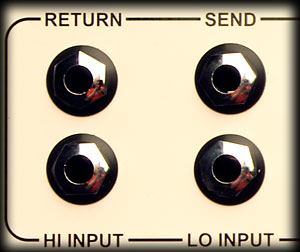
Many amps have two inputs (though some have more than this), with
one being the “HI” input and the other being the “LOW”. What should be
remembered when considering the two inputs is that the choice won’t
change the sound or EQ of the signal, but rather the level of the
signal, which also often affects volume sensitivity.
|
|
What happens is the that the HI input actually cuts the input
signal, while the LOW input will leave the signal exactly as it is when
it enters the amp. But the reasons for choosing one or the other vary
depending on your instrument and your amp.
For example, some bass amps advise players using a bass with active
pick-ups to use the HI input, while it is recommended that those using
passive pickups plug into the LOW input.
As for guitars, the choice is also dependent on what type of pick-up
is used. Guitarists using new, bright humbuckers might want to choose
the HI input to tame the hot signal, while a player using vintage
single coils may want to go with the LOW input to ensure that all of
the true sound of the pick-up is replicated.
But, as is usually the case, there is no right answer, other than
the option that sounds better to your ears. The amount the signal is
cut in HI inputs varies widely from amp to amp (anywhere from 6 dB to
15 dB is common), and so do pick-up types. Test out which works best
for your instrument – some players use one jack for one guitar and the
other for a different axe (though it should be noted that for some
amps, including some Fenders, both inputs become identical if both
inputs are occupied). |
|
Why is there a microphone output on my guitar?
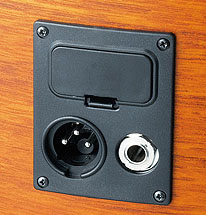
Some acoustic guitars will have a DI box built in, meaning that they
have a Lo-Z (XLR), or balanced output in addition to the usual
quarter-inch Hi-Z output. When acoustic guitarists plug into a preamp,
it is almost always advisable that they first plug into a DI box,
particularly if the signal has to travel across a long distance. The DI
box converts the signal from unbalanced to balanced, which in the end
produces a much better and clearer sound.
Guitars with an inbuilt Low-Z output skip the DI box step
altogether, and can plug straight into the preamp. If you have the
choice of both, you would typically only want to use the Hi-Z
(quarter-inch) output if you are plugging directly into a guitar amp.
Otherwise, it is best to go with the Low-Z (XLR) output.
By Tom Graham
|
 |
|
Related Items
|
#4303 |
Stage Series Balanced XLR Microphone Cable - RED
Suitable for connecting 3pin microphones to other audio equipment with XLR inputs. Capable of carrying both balanced "microphone level", and balanced "line level" signals. Featuring professional standard Ningbo Neutrik connectors, thick 0.22mm2 OFC conductors covered by individual "spiral wrapped...
Price: AUD 14.99
FREE SHIPPING
|
|
#2586 |
Stage Series Guitar Lead
Swamp has designed the stage series cables for use by musicians in live performance, regular practice and general studio connections. Featuring quality Ningbo Neutrik connectors, thick 0.22mm2 OFC copper conductors and a full coverage spiral wrapped ground shield
Price: AUD 14.99
FREE SHIPPING
|
|
#4417 |
Radial JDX Reactor Guitar Amp Direct Box
RADIAL JDX Reactor Guitar Amp Direct Injection (DI) Direct Box. Perfect for performing guitarists that want a consistant sound in their monitor mix, night after night, no matter the venue or sound technician. Eliminates the need for a Microphone.
RRP: AUD 279.99
Price: AUD 209.99
save 25%
|
|
#3898 |
Acoustic / Electric Guitar - Jumbo Body Steel String
Great acoustic / electric guitar for beginner and intermediate guitarists. Being a steel string guitar it has the classic acoustic sound, found so often in rock and country music. A large hollow body means it can be played without the need for further amplification.
Price: AUD 219.99
FREE SHIPPING
|
|
#4325 |
Rowin LT-36 Piezo Clip On Chromatic Tuner (Blue)
LT-36 Clip-on Piezo Tuner. The Rowin LT-36 tuner is amazingly accurate and easy to use. Clips onto the head-stock of any stringed instrument (including guitars) for the simplest tuning you have ever experienced! Intuitively helps you tune your acoustic instrument by displaying the note name being...
Price: AUD 14.99
|
|
Comments on Hi-Z and Low-Z Inputs and Outputs
Be the first to comment on this entry!
Share comments
|
|