home Contact Us Specials About Us Shopping Cart
Swamp Industries
NEXT DAY DISPATCH
12hr 11min left
Search Swamp

PRODUCTS

AUDIO CABLES

GUITAR EQUIPMENT

PRO AUDIO


BRANDS
AC-Audio
Alctron
Alice
Atlona
ART
Blue Microphones
Daphon
Dekk
EC Custom
Beta Aivin
iSK
MOEN
Neutrik
Ningbo Neutrik
Radial


Leave Us Feedback
Swamp :: Swamp Content ::  Articles ::  Microphone signal into Guitar Amp (Hi-Z)

Microphone signal into Guitar Amp (Hi-Z)

Microphone signal into Guitar Amp (Hi-Z)
Category: Articles
Posted: 23-08-2010 11:38:00 PM
Views: 7925
Comments: 5 [Read/Post]
Synopsis: Singers and vocalists will sometimes find themselves needing to plug their microphone into a guitar amplifier. Often for practice with other band members or in the home environment.

Though a guitar amp has its name for a reason; the input jack is designed for high impedance (Hi-Z) guitar signals, through a ¼” jack connector. While a microphone outputs a low impedance (Low-Z) mic level signal and the standard cable connector is a 3pin XLR.

There are ways to overcome the difference in signal and cable connectors to get the correct connection and optimum signal strength from the microphone.

Singers and vocalists will sometimes find themselves needing to plug their microphone into a guitar amplifier. Often for practice with other band members or in the home environment. A guitar amp is often a practical and inexpensive way to get your vocals amplified. They are relatively inexpensive compared to full 2-way PA systems that are generally used for vocals in a live environment.

Though a guitar amp has its name for a reason; the input jack is designed for high impedance (Hi-Z) guitar signals, through a ¼” jack connector. While a microphone outputs a low impedance (Low-Z) mic level signal and the standard cable connector is a 3pin XLR. There are ways to overcome the difference in signal and cable connectors to get the correct connection and optimum signal strength from the microphone.

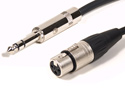
Firstly to plug a mic into a guitar amp you will need a cable with the correct connectors on either end. Most microphones require a 3pin XLR(f) connector to plug into the bottom of the microphone. Just about all guitar amplifiers have a ¼” jack input and require a standard ¼”(m) jack connector (found on any guitar lead). Thus an XLR(f) to ¼” jack cable is needed to connect the microphone directly to the amp.


This is standard cable purchased by those wishing to plug their microphone into their guitar amp. While the connections may be correct and sound will definitely come through, there is still a difference in ‘impedance’ between the signal from the mic (Low-Z), and the input on the guitar amp (Hi-Z). The result is a loss of signal (voltage) which will restrict the volume to around 80% of full potential and will also reduce signal clarity somewhat.

To overcome this loss in signal due to an “impedance mis-match”, there is a clever device known as an impedance transformer. The inner circuitry of the impedance transformer turns the impedance of the low-Z mic signal into hi-Z, suitable for the input on the guitar amp.


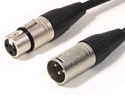
The impedance transformer above does have the correct XLR(f) to ¼” jack connectors, required for the mic to guitar amplifier connection, though unless you want to be singing with your ear against the amp, a longer cable will be needed. A standard XLR(f) to XLR(m) cable will do the job.


The XLR(f) plug goes into the microphone, while the XLR(m) plug is connected to the XLR(f) connector on the impedance transformer. The ¼” jack connector can then be plugged directly into the guitar amp. Tadaa!


Related Items

#2868 Swamp Impedance Transformer XLR(f) 1-4(m) - Mic to Hi-Z Guitar Amp

Impedance transformer, 50k ohms to 600 ohms. Connect a Mic to a Guitar Amp. Low-Z to Hi-Z transformer maximises signal transfer and clarity. If you attempt such a connection without using such a device, the output signal from the amp will be much lower

Price: AUD 18.99
FREE SHIPPING
Quantity
Add to Cart


Comments on Microphone signal into Guitar Amp (Hi-Z)


SWAMP - Tom 25-07-2012 03:49:13 AM
Hi John. If you have a Low-Z mic with a cable attached that cannot be removed, ending in a 1/4" plug. Then a 1/4"(f) to XLR(m) adapter would enable you to use the XLR(f) 1-4(m) impedance converter that we stock. We will keep your need in mind, and may get some in with 1/4"(f) to 1/4"(m) connectors!
John Ford 25-07-2012 01:55:55 AM
Hi, Nice work, that explanation. I have a mic Lo-Z mic with 1/4" jack on the cable, so could use 1/4" socket Lo-Z to 1/4" plug Hi-Z. Anything availabale? Thanks - need a couple of them actually. Regards, John
IrishPaul 07-06-2012 10:41:00 AM
Thanks guys, exactly the info I needed to convert my second hand guitar amp into perfectly working PA system without any fuss.
Joana 08-12-2010 06:35:21 AM
Thanks a lot!!! I was desperate to read an article like this! It's perfect. Thanks again!
Greg 30-09-2010 09:10:22 PM
Thanks guys! Using the impedance transformer in the signal chain has dramatically improved the quality of the sound, and yes some extra volume too.


Share comments

Your Name: *
Comments: *
Please Note: HTML Markup will be automatically removed.
The ability to post urls has been disabled by the site administrator.
*

Get a different code
 
Cart is empty
 

View cart
Checkout
Wish list
Orders history


E-mail

Password


Remember Me
Log in 
Register 
Recover password

If Javascript is disabled in your browser click here


Subscribe 


Recent Posts

Categories


Recent Reviews


30 day money back
Comparison Shopping Australia - Certified by Getprice
Payment Options

ECMTA Certified Merchant - click to verify


Home | Contact | Specials | About Swamp | Cart | eBay Store | Site Map

Swamp Industries Pty Ltd | swamp.net.au | ABN 64665059242 | PH: 02 61622725