























Guitar Pedal Order: How to Arrange Your Signal Chain
Author: SWAMP Industries
Posted: 28 November 2026
Synopsis: The standard pedal chain explained slot by slot - what goes where and why, FX loop basics, when to break the rules, and how to power and patch your board.
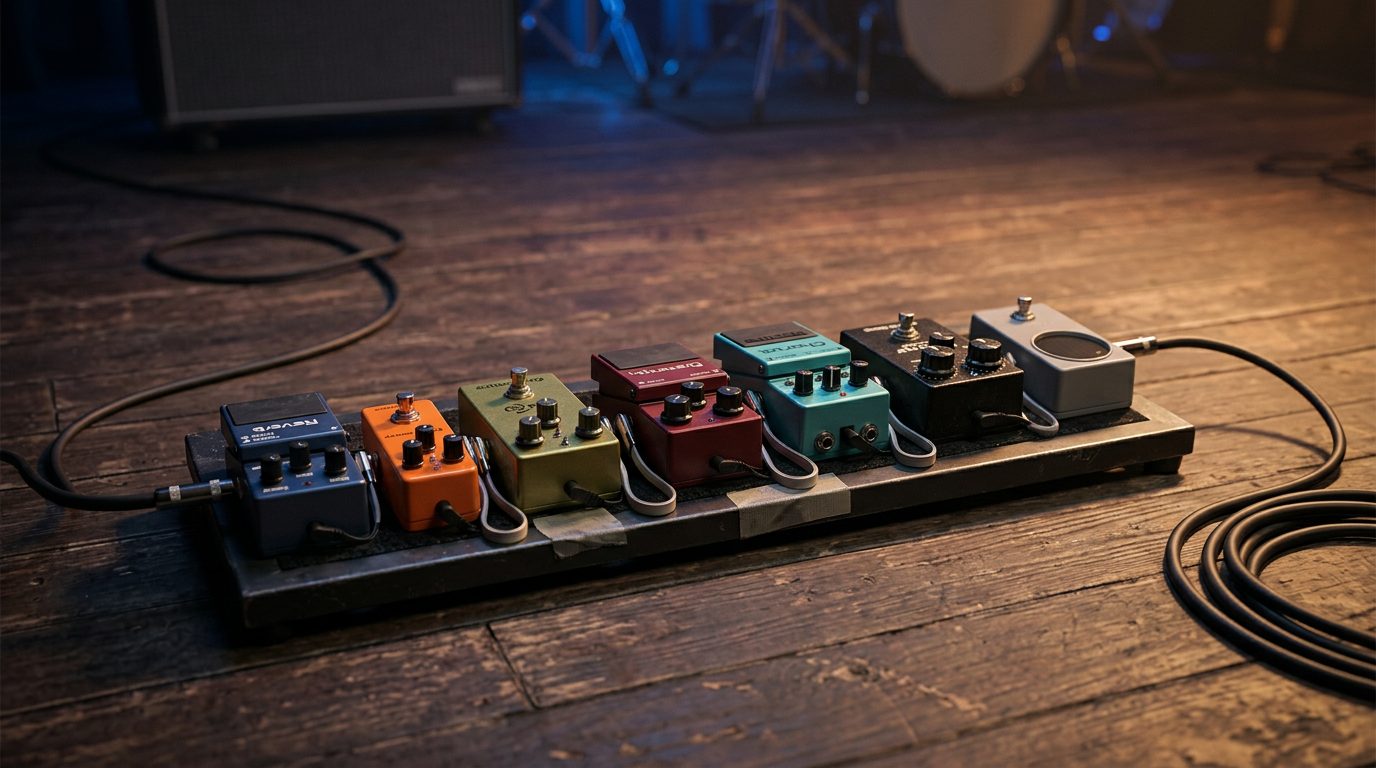
The standard guitar pedal order is: guitar → tuner → filters and wah → compressor → overdrive and distortion → modulation (chorus, phaser, flanger) → delay → reverb → amp. Dynamics and gain effects go early, time-based effects go last, and the tuner goes first so it reads a clean signal.
The rest of this guide explains why the order works, what happens when you move effects, where the amp's FX loop fits, and how to power and patch the board so it stays quiet. These are starting points, not laws. Once you understand what each pedal is processing, you can move it deliberately to change the sound.
- Tuner first→it needs the cleanest possible signal to track accurately (and mutes the whole board while you tune)
- Wah and filters early→sweeping the raw guitar signal before drive gives the classic vocal "wah", not a harsh fizz sweep
- Compressor before drive→it evens out your picking dynamics so the drive pedal receives a consistent level
- Drive in the middle→overdrive, distortion and fuzz create the core tone that everything after it decorates
- Modulation after drive→chorus and phaser sound lush on a distorted signal, but muddy when distorted themselves
- Delay near the end→echoes of a distorted note sound musical; distorting a stack of echoes sounds like a mess
- Reverb last→it is the room your whole sound sits in, so everything else feeds into it
The standard pedal order, explained
Find a pedal for each slot in the SWAMP guitar pedals range. All prices are live and include any current promotion.
1. Tuner - first in line, always
A tuner pedal wants the purest version of your guitar signal. Put it after a drive or modulation pedal and it has to guess at a note buried in harmonics, so it tracks slower and less accurately. First position also means stomping it mutes the entire board for silent tuning between songs. The Rowin LT-901 mini chromatic tuner ($31.49) does the job in a footprint smaller than your phone - see all tuner pedals.
2. Filters and wah - sweep the clean signal
Wah, auto-wah and envelope filters shape the frequency content of your raw guitar signal. Placed before drive, the filter sweep gets amplified and saturated by the gain stages after it, which is the vocal "wacka-wacka" everyone recognises. Placed after drive, the wah is sweeping an already-fizzy signal and turns thin and harsh. The JOYO WAH-1 dual mode wah and volume ($98.99) covers both jobs in one treadle - more in wah pedals.
3. Compressor - even out the peaks before the gain
A compressor narrows the gap between your softest and loudest picking, adding sustain and consistency. Early in the chain it feeds every following pedal a steady level, which makes drive pedals respond predictably. Put it after distortion and it amplifies the noise floor instead. Try the JOYO Ironman JF-312 Pipebomb ($84.99) - see all compressor pedals.
4. Drive - overdrive, distortion and fuzz
This slot defines your core tone. Running boost into overdrive into distortion (in roughly increasing gain order) lets you stack them for solo lifts. For a transparent low-gain drive, the Mosky Silver Horse ($49.99) is a lot of pedal for the money; for a heavier voice, the JOYO JF-23 Argos ($64.99) brings classic rock distortion. Browse overdrive and distortion pedals.
5. Modulation - chorus, phaser, flanger, tremolo
Modulation effects add movement. After drive, a chorus thickens and widens your distorted tone; before drive, that shimmering, detuned signal gets crushed into mud by the gain stage. The JOYO JF-37 Analog Chorus ($68.99) is a warm, classic-voiced starting point - see all chorus pedals.
6. Delay - echoes of the finished tone
A delay pedal repeats whatever it receives. Fed your finished, driven, modulated tone, each repeat is a clean copy that fades naturally. Put delay before distortion and every repeat gets re-distorted, smearing into noise (unless that lo-fi wash is exactly what you want - see below). The JOYO D-SEED II dual channel delay ($138.99) covers digital, analog and tape-style repeats - more in delay pedals.
7. Reverb - the room, last of all
Reverb simulates the space your sound lives in, so it comes after everything that shapes the sound itself. Real rooms do not sit between your distortion and your delay. The JOYO Ironman JF-317 Space Verb ($99.99) fits the smallest boards - see all reverb pedals.
Why this order works: gain staging in plain language
Every pedal changes the signal, then hands the result to the next pedal. So pedal order is really a question of what should each effect be listening to? A compressor should hear your raw picking dynamics, not a distorted wall. A wah should sweep a full-range guitar signal. A delay should echo the finished product.
The chain also runs from level-sensitive to level-insensitive. Dynamics effects (compression) and gain effects (drive) react strongly to how hard the incoming signal hits them, so they belong early where the signal is predictable. Time effects (delay, reverb) repeat or add ambience to whatever arrives, so they work anywhere but usually sound cleanest at the end.
Every gain stage amplifies the hiss of everything before it. Keeping the gain pedals in one tight group near the front, with the quiet time effects after them, keeps the total noise floor down. If your drive stack still hisses, a noise gate placed straight after the drive pedals (see the FAQ) clamps it.
The FX loop: where time effects go when the AMP is your distortion
Everything above assumes your drive comes from pedals into a clean amp. If you use the amp's overdrive channel, its preamp distortion happens after every pedal connected to the front input. That puts delay and reverb before the distortion, where the repeats can become smeared.
The FX loop solves this. It is a send and return socket pair on the back of the amp that inserts pedals BETWEEN the preamp (where the distortion happens) and the power amp (which just makes it loud). Run modulation, delay and reverb in the loop and they stay after the distortion, where they belong.
Do you actually need to use the FX loop?
- Clean amp + drive pedals: no. Run everything into the front in the standard order.
- Amp's overdrive channel is your main sound: yes, if your amp has a loop - put modulation, delay and reverb there.
- No loop on your amp: keep delay and reverb subtle at high gain, or get your drive from pedals instead.
Power and patching: the part that makes or breaks the board
Once the order is right, the difference between a board that works and a board that whines, hums and cuts out is almost always power and cabling.
Daisy chain or isolated power?
A daisy chain runs several pedals from one adapter - cheap and fine for a few low-current analogue pedals. The JOYO 9V supply with 8-way daisy chain ($58.99) will happily run a starter board. But digital pedals (delay, reverb, multi-effects) draw more current and shared power lines can introduce whine. A multi-output power station like the SWAMP DC CORE 10 ($51.09, with 9V, 12V and 18V outputs) is the sensible mid-step, and a fully isolated supply like the SWAMP ISO-10 ($99.99) gives every pedal its own clean, separated output - the cure for ground-loop hum on bigger boards. Browse all pedal power supplies.
Patch cables: short, flat and shielded
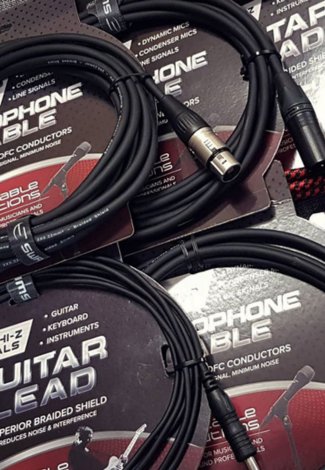
Every extra metre of cable between pedals is extra capacitance quietly rolling off your top end, and every cheap plug is a future crackle. Use the shortest patch cables that reach, with low-profile connectors so pedals pack tighter. The SWAMP flat connector 20cm patch cable ($3.65) and the RockBoard flat patch series (from From $6.37) are built for this. See the full guitar patch cable range.
Pedalboard sizing: buy one slot bigger than today's board
Count your pedals, add the power supply footprint, then add room for the one pedal you have not bought yet (there is always one more). The SWAMP PDB-60M ($119.99, 60x30cm) fits a typical 6-8 pedal chain with power underneath, and the RockBoard TRES 3.1 with gig bag ($128.99) is a gig-ready grab-and-go option. Compare sizes in pedalboards, or read the full pedalboard buying guide.
Guitar pedal order FAQ
Does pedal order really matter?
Yes - the same pedals in a different order produce a different sound because each pedal processes the output of the one before it. Wah before distortion sounds vocal; wah after distortion sounds thin. Delay before distortion smears; delay after distortion stays articulate. Order matters most around the gain pedals, and least between two pedals of the same family.
Where does a tuner pedal go?
First, straight after the guitar. It tracks the clean signal fastest and most accurately there, and stomping it mutes the whole board for silent tuning. The only common exception is placing it after a dedicated volume pedal so you can tune with the volume rolled off.
Buffered or true bypass pedals - does it change the order?
The order stays the same. True bypass pedals pass the signal untouched when off, but a long chain plus 6+ metres of cable dulls your treble. A buffered pedal (many tuners are buffered) refreshes the signal. One decent buffer near the front of the chain keeps everything bright; all-true-bypass boards benefit from a buffered tuner in slot one.
Where does a noise gate go?
Immediately after the noise source it is gating - normally straight after your drive/distortion pedals and before modulation. Gating at the very end of the chain also chops off your delay and reverb tails, which sounds unnatural. A compact option is the Rowin LEF-319 mini noise gate ($53.99) - see all noise gate pedals.
Does a looper pedal go last?
Yes, dead last (after reverb, or in the FX loop's final position with a high-gain amp). A looper is a recorder: placed last, it captures your finished sound, and every loop layer keeps its own effects. Placed earlier, all your loop layers get re-processed by whatever comes after, so changing a delay setting changes every layer at once. Browse looper pedals.
Can I run pedals into the front of any amp?
Yes. Every guitar amp's instrument input handles a pedalboard fine - that is the standard rig. The FX loop question only arises when the amp's own overdrive is your main distortion sound. If you play clean-ish amps or get your gain from pedals, you never need to touch the loop.
Build the chain, slot by slot
Tuners, wahs, drives, modulation, delay and reverb - plus the boards, power and patch cables that tie it all together. Live stock and fast dispatch from our Canberra warehouse.
Shop all guitar pedals Ask the team